Healing Political Divides — Rebuilding What Was Broken: For Those Whose Relationships Have Been Damaged…
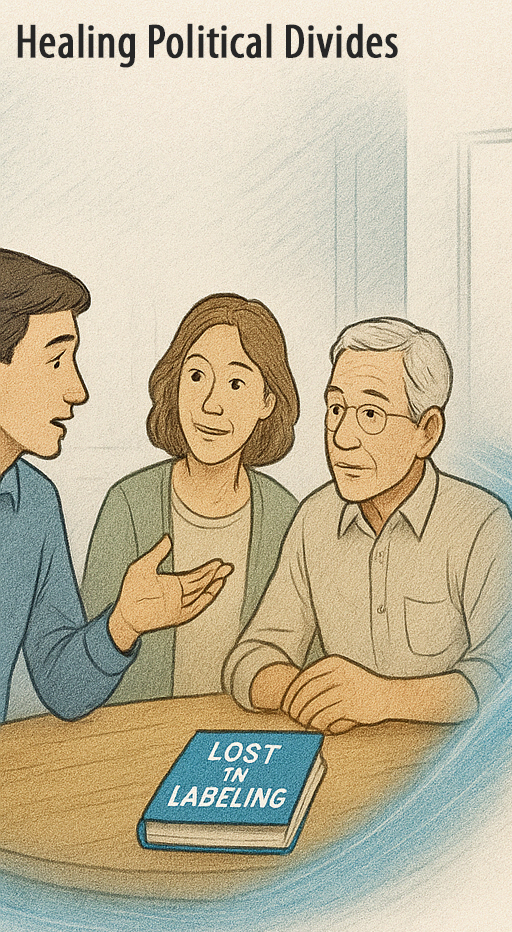
When I wrote Lost in Labeling, I wrote it for all of us who have felt the sting of losing someone we love to the forces of political hostility. I have lived long enough to see what happens when ordinary people—good people—are swept into cycles of outrage that were never of their own making. And together, in these pages, you and I explore not only what went wrong, but how we begin to reclaim the humanity we once shared. The truth is, none of this division happened by accident. We were pushed into corners, divided into categories, fed outrage, and conditioned to distrust. And for many families, that manipulation tore a hole straight through the center of what should have been lifelong connection. To begin healing, we first have to understand what was done to us—and why.
POINT ONE: THE RAGE MACHINE THAT TORE US APART
“Social media feeds us rage… And what do we get in return? Loneliness. Anxiety. Broken families.” — Lost in Labeling, p. 8. When I speak about families breaking under political pressure, I’m not guessing. I’m describing a system designed to keep us in conflict. Together, we explore how social media algorithms reward anger, highlight extremes, and silence moderation. These platforms do not thrive when we feel calm. They thrive when we feel threatened, indignant, or superior. And so, people who once loved each other find themselves speaking a different emotional language entirely—one built not on shared history, but on digital manipulation. And it is pure, purposeful science and technology.
“Everywhere we turn, we are given a new reason to divide, to distrust, to despise… We live in a world where the very thing that should bring us together—our shared humanity—is being shredded by the relentless push to categorize, separate, and despise.” — Lost in Labeling, p. 8. When we explore this together, we look at how these forces of division seep into families. We talk about the mechanisms behind the outrage: the headlines crafted to provoke us, the commentary designed to radicalize, the digital spaces that make us believe our loved ones are suddenly “the enemy.” And as we walk through these layers, we begin to see the truth that division is not a reflection of our character—it’s the predictable result of a system fueled by emotional exploitation. Understanding that truth is the first step back toward each other.
POINT TWO: SEEING THE HUMAN STORIES BEHIND BELIEFS
“Friendships wither… Families fracture, afraid to speak openly.” — Lost in Labeling, p. 9. Every belief has a birthplace. In our journey, we pause to explore what shaped the people we love long before politics ever entered the conversation. Sometimes it was fear. Sometimes hardship. Sometimes the hunger of an empty childhood. Sometimes the terror of war, bombs falling through the night, or escaping a country where speaking truthfully could cost your life. These experiences matter. They explain more than ideology ever could.
“When we refuse to see humanity in those who think differently, we don’t just hurt them—we rob ourselves of a world that is brighter, kinder, and full of possibility.” — Lost in Labeling, p. 9. Together, we explore how people’s histories shape their beliefs, and how compassion—not agreement—can restore connection. You’ll see how generational trauma influences political instincts, how survival environments produce certain values, and how understanding origin stories reduces judgment. This isn’t about excusing harm. It’s about helping you understand why someone you love may have become someone you barely recognize—and how understanding their “why” can soften the barrier enough to allow conversation again.
WHY THIS MATTERS FOR YOU
By the end of this section in the book, my goal is for you to breathe a little easier. Not because everything is fixed, but because
everything finally makes sense. You begin to see that the fractures in your family were not proof of moral failure—they were symptoms of a society pulled apart at the seams. And once you understand the forces that shaped this division, you regain the ability to lead conversations instead of fearing them.
IN ADDITION TO ALL OF THIS, YOU WILL ALSO LEARN…
- Why political labels were turned into weapons
- How fear-based messaging manipulates our emotions
- What psychological instincts make us vulnerable to “us vs. them” thinking
- How media incentives profit from keeping us angry
- Why misinformation spreads so easily in moments of uncertainty
- How to recognize when a loved one is reacting from fear rather than conviction
- How to rebuild rapport without compromising your values
- Why curiosity is more powerful than debate in repairing relationships
This is not just a book. It’s a companion for those who want to reclaim the possibility of connection—and lead others back toward it. I hope you will find it worthy of your time and share it with others to warm your circle again.
View suggested discussion guides for various groups here: Start the Conversation.