
Reviews from Readers of Lost in Labeling…
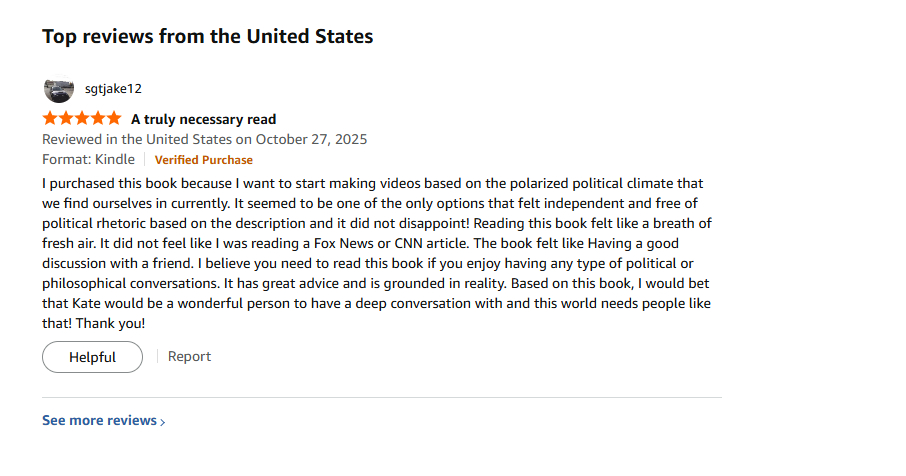
“Book Review: Lost in Labeling: Ignorance-Fueled Hatred as Political Ideology in America by Kate Maclaren
In an age when conversation has collapsed into confrontation and understanding has been replaced by outrage, Lost in Labeling emerges as both diagnosis and antidote. Kate Maclaren has written a book that dares to treat America’s ideological fractures not as weapons to wield but as wounds to heal. With the steady insight of a historian and the empathy of a teacher, she traces how our modern identity politics—left, right, and everything in between—have devolved into tribes defined by slogans rather than substance.
As a political author and educator, I’m struck by how fair this book is. Maclaren does what most pundits won’t: she walks us through the history of competing ideologies with genuine balance, refusing to vilify either side. Instead, she offers clarity where others deliver noise. Her prose is precise and unflinching, yet warm—never shaming, never lecturing. Readers on any side of the political spectrum will see their own reflections here, but more importantly, they will see how easily our convictions can be hijacked by manipulation.
That manipulation—Maclaren makes clear—is not theoretical. It is coded, calculated, and automated. Her discussion of media algorithms is among the most important sections of the book. We are not simply consuming information anymore; the information is consuming us. News feeds are engineered to heighten anger because anger holds attention, and attention sells. It is a sobering look at how digital platforms now write their own narratives, amplifying resentment and rewarding hostility with virality. The book doesn’t just expose this—it contextualizes it within the broader history of propaganda and social engineering, revealing how profit models have become ideological engines.
But Lost in Labeling is not a book about despair. It is about the profound possibility of healing when we recognize what’s being done to us—and how we participate in it. Reading it is an act of quiet reckoning. You begin to see your own assumptions soften, your empathy deepen, your perspective widen. Maclaren doesn’t ask readers to abandon their beliefs; she asks them to reclaim the dignity of dialogue.
This book could not have arrived at a more crucial moment. America is shut down—not by lack of resources or will, but by the barricades we build from our own labels. Maclaren shows us that coexistence does not require agreement, only respect, and that respect begins with understanding how we got here. Lost in Labeling should be required reading in every political science and media studies classroom in the country. It is that rare work of non-fiction that enlightens both the mind and the conscience. – Mark”
Book of the Month – Eregendal Publishers
“For our Book of the Month, I have chosen Lost in Labeling: Ignorance-Fueled Hatred as Political Ideology in America by Kate Maclaren, first published in 2025 and available on Amazon and through her website. Kate is an educator based in North Carolina, where she lives with her husband, family, and a ‘lively menagerie.’
Lost in Labeling is an intelligent analysis of how the misuse of language and the meanings behind words are fuelling polarised political debate and dividing friends, families, and communities, fracturing the unity of the United States. Its message is equally relevant to the UK and other countries where people use soundbites and algorithms to court popularity rather than engage in reasoned and reflective personal and public debate.
I loved reading this book. As a person who cares about using words correctly and tries to understand the nuances behind political propaganda, I appreciated the way it calls out such lazy thinking as demonising through misuse of political labels, misuse of the ‘us versus them’ mentality with its polarising ‘if you don’t agree with us, you are one of them’ misinformation, biased news and ‘falsism’ including the use of coded ‘dog whistles’ in politics where simple phrases have loaded meanings.
The book encourages readers to start thinking critically, to counter false claims, and to verify the truth of a statement before liking or reposting it. Personal integrity can then become counter-cultural, helping to change the political landscape to a more accountable one, one person at a time. Listening then becomes respecting another person’s viewpoint without needing to agree with them. Among many quotable sections, the author writes, “This kind of respectful dialogue not only strengthens our communities but sets a powerful example for the next generation.”
This is the sort of book I would have loved to have spent a term working through with students when I taught PSHE (a UK school curriculum subject designed to help pupils develop the knowledge, skills, and attributes they need to keep themselves healthy, safe, and prepared for life and work) in senior schools. It contains plenty of material for reflection and debate. The book is also a salutary reminder of the power of our words to elevate or destroy, long after we have left school and make our way in the world. Finally, it encourages us as voters and citizens to take politicians and journalists to task about their loaded use of language and urges them to greater veracity in spoken word and in print. Maggie”
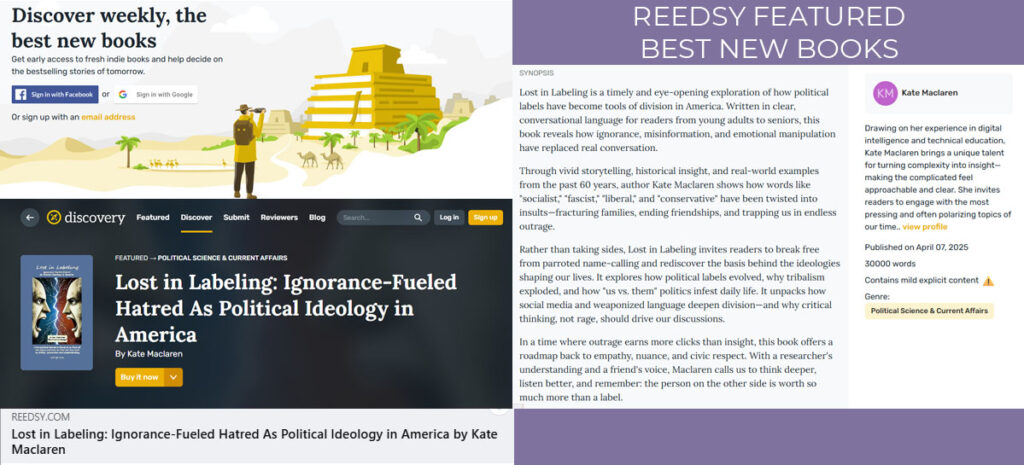
“Kate Maclaren’s Lost in Labeling is a bold and necessary wake-up call in an era when political discourse feels more like a battlefield than a conversation. With striking clarity and compassion, Maclaren disects how ignorance-fueled hatred, emotional manipulation, and social media echo chambers have turned words like ‘liberal’ and ‘conservative’ into weapons, instead of ideas.
Drawing from sixty years of political evolution, she traces how America’s obsession with labels has eroded empathy, fractured relationships, and replaced curiosity with contempt. Yet at its core, Lost in Labeling isn’t just a diagnosis – it’s an invitation. An invitation to think critically, listen deeply, and rediscover the humanity buried beneath the noise.
If you’ve ever wondered whether unity is still possible in a culture addicted to outrage, this book just might change how you see every ‘debate’ from here on out. With genuine sincerity, Serene”
I just wanted to say – RESPECT. Writing in the political genre takes serious skill. It’s not easy keeping tension high and pacing tight, but your work has really nailed that balance between plot and momentum. Best regards, Margaret.